How to Choose Weatherproof Outdoor Rugs for a Patio That Lasts
An outdoor rug is one of the few decor purchases that changes how a patio feels the moment you unroll it. Suddenly there is a boundary, a color anchor, a reason to leave your shoes by the door. The trouble is that plenty of rugs sold as "outdoor" are indoor rugs with a water-resistant coating, and one season of sun and rain leaves them faded, curled at the corners, and smelling faintly of wet basement. Choosing well comes down to four things: fiber, weave, size, and construction.
Start With the Fiber, Not the Pattern
Pattern is the fun part, but it is also the easiest thing to change. Fiber decides whether the rug is still on your patio in two years.
Synthetics: the safe default
Polypropylene, often labeled olefin, is the workhorse. It does not absorb water, it resists mildew, and solution-dyed versions keep their color because the pigment runs through the fiber rather than sitting on the surface. It can feel a little slick underfoot, but in a flat weave that hardly matters.
Rugs made from recycled PET bottles perform similarly and often have a denser, more textile-like hand. Acrylic is the softest of the synthetics and holds color beautifully, but it dries more slowly than polypropylene, which makes it a better fit for a covered porch than an open deck. Polyester sits in the middle: decent fade resistance, but it can pill and it hangs onto moisture longer than you would like.
Natural fibers: beautiful, but picky
Sisal, jute, coir, and seagrass look wonderful and photograph even better. They are also the wrong choice for an exposed patio in a wet climate. Jute mildews quickly and stains permanently. Sisal handles dry heat well but spots if it gets soaked. Coir is coarse and stiff, which makes it excellent for scraping shoes at a door, and poor for bare feet. If you love the natural look, put it on a covered porch with a roof overhead and understand you are trading longevity for texture.
One label detail worth checking: solution-dyed or UV-stabilized. Both indicate the manufacturer expects the rug to sit in the sun, which is exactly what you are asking of it.
Flat Weaves Dry Faster Than Plush Ones
Pile height matters more outdoors than indoors. A thick, cut-pile rug soaks up water like a sponge, mats down under damp furniture legs, and gives mildew a place to settle. Anything over roughly a quarter inch belongs inside.
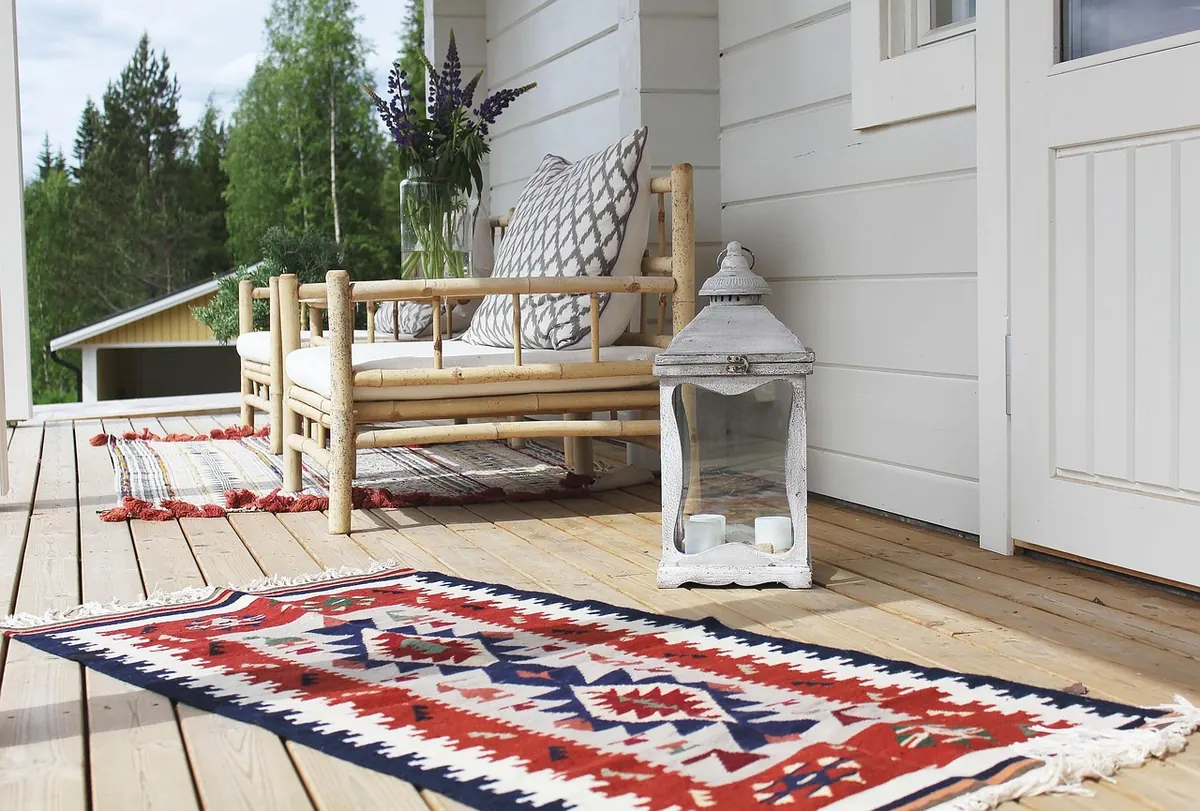
Look for flatweave, low-loop, or tightly braided constructions. Loop pile in particular drains well, sheds dirt, and stays flat when a chair is dragged across it. If you want some softness, choose a low loop rather than a shag. Your bare feet will not notice the difference on a warm day, and your rug will dry in hours instead of days.
Size Rules That Keep Chairs on the Rug
An undersized rug is the most common outdoor decor mistake. A postage stamp floating in the middle of a patio makes furniture look scattered rather than arranged. A few rules cover almost every situation:
- Seating areas: the front legs of every piece of furniture should sit on the rug. If the rug is large enough, all four legs is better. A sofa with its back legs hanging off looks unsettled.
- Dining tables: allow about 24 inches of rug beyond each edge of the table so chairs stay on the rug when they are pulled out. A round table wants a round or square rug, not a rectangle.
- Sliding doors and walkways: a runner along the door track catches grit before it reaches the house and visually connects the patio to the garden.
- Leave a border. On an open patio, keep 12 to 18 inches of bare surface between the rug edge and the patio edge. Water needs somewhere to run, and the gap makes the rug look intentional rather than wall-to-wall.
Before ordering, tape the outline on the patio with painter's tape and live with it for a day. A 9x12 rug sounds generous until you see how much of a narrow deck it eats.
Backing and Edges: The Details Nobody Checks
Turn the rug over. What you see there decides how it behaves after a rainstorm.
An open, mesh-like backing lets water pass through and air circulate underneath. A solid rubber or latex backing, the kind that keeps an indoor rug from sliding, can trap moisture between the rug and the concrete. On a covered porch that is fine. On an exposed patio it is a recipe for a damp, discolored underside.
Edges matter too. Bound edges resist unraveling, and a rug with a clean, tightly finished border will outlast one with loose fibers at the corners. If you use a pad, choose an open-mesh outdoor pad, or skip it entirely on an exposed surface where water needs to drain freely.
Care That Adds Seasons
Outdoor rugs are forgiving, not indestructible. A little routine goes a long way:
- Sweep or vacuum weekly. Grit works its way into the weave and acts like sandpaper on the fibers.
- Rinse and scrub a few times a season. Mild soap and a stiff brush are enough. Skip bleach unless the care label specifically allows it, and never use a pressure washer on a narrow, high-pressure setting.
- Dry it flat and on both sides. Lift the rug after a heavy rain so air reaches the underside. If it is light enough, drape it over a railing for an afternoon.
- Rotate it. Sun fades one side faster than the other. Turn the rug every few weeks and the color stays even.
- Store it dry for winter. Roll it, do not fold it, and keep it somewhere with airflow. Folding a damp rug creates creases that never quite come out.
For mildew, a diluted vinegar solution followed by a thorough rinse and full sun exposure handles most cases. Test any cleaner on a hidden corner first.
Color, Heat, and Where the Rug Actually Sits
On sun-baked stone or composite decking, a dark rug soaks up heat and can be uncomfortable underfoot at midday. Lighter tones and mid-range earth colors stay cooler and show dust less obviously. Busy patterns are the practical choice if you have pets, kids, or a grill nearby, since they camouflage small stains that a solid ivory rug would broadcast.
Then step back and look at how much weather the spot really gets. A fully covered porch can handle acrylic, cotton blends, and even a natural fiber. A semi-covered patio wants solution-dyed polypropylene in a flat weave. A wide-open deck in a rainy climate is a job for the toughest synthetic you can find, and even then you should expect two or three good years rather than ten.
A Simple Buying Order
Measure your space and tape the outline. Decide how exposed the spot is. Then pick fiber, weave, and size in that order, and only afterwards choose the color. Read the care label before you buy, not after the first storm. Do that, and the rug becomes the thing that makes the patio feel finished, instead of the thing you replace every spring.
Photo: boutiquerosa / Pixabay